
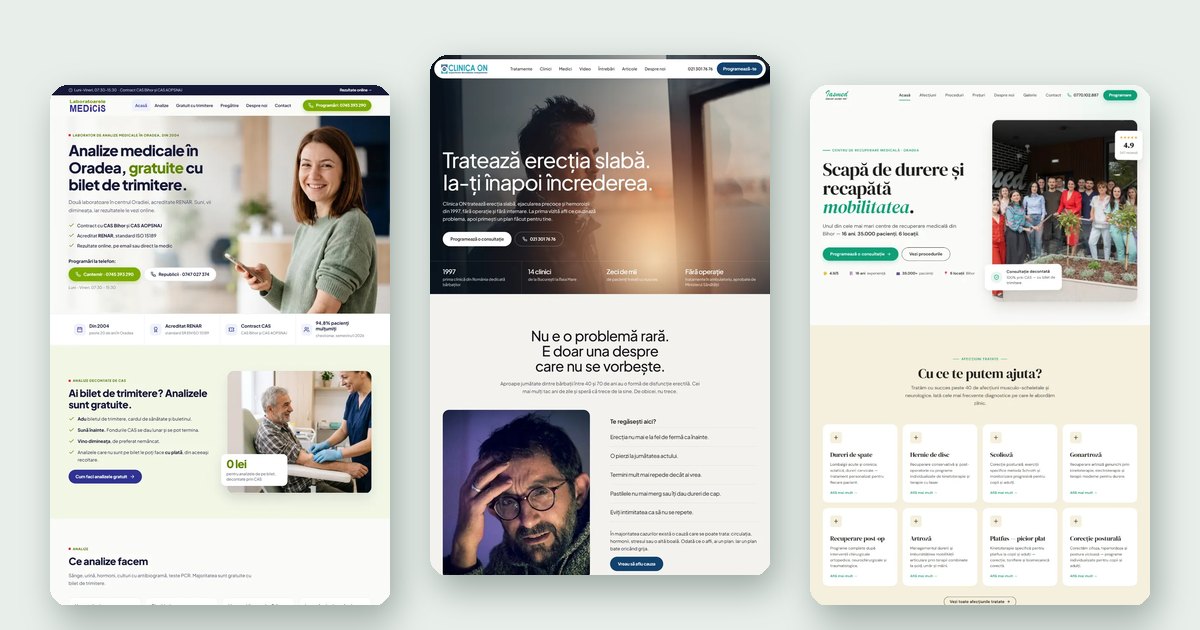
A patient on your website has one question: should I call this clinic? A good medical clinic website answers it before they scroll. Most clinic sites answer other questions first, like when the clinic was founded or what the director believes in, and the patient leaves for the next result on Google.
We recently built three medical sites: Laboratoarele Medicis, two blood-testing labs in Oradea; Clinica ON, a men's health clinic with 14 locations across Romania; and Iasmed, a rehabilitation and physiotherapy centre with six locations in Bihor. Different patients, different problems. The list below is what all three have in common, and what we'd put on any clinic website before anything else.
1. The first screen decides whether they call
Someone looking for a clinic is usually in pain, worried, or doing it for a parent. They want three things: the phone number, the opening hours and where you are. If they have to open the Contact page to find them, you've already lost some of them.
On the Medicis home page, the hours (Monday to Friday, 07:30 to 15:30) sit in the very top bar, and under the headline there are two phone buttons, one for each lab: Cantemir and Republicii. A patient who already knows which lab is closer taps that one. Nobody has to wonder which number reaches whom.
The phone number should be a real tel: link, big enough to hit with a thumb, and in the header on every page. Most of your visitors are on a phone, so a number they can't tap is just a number to copy and get wrong.
2. Answer the money question first
Before patients ask anything medical, they want to know what it will cost them. If your site doesn't say, they assume it's expensive, or they call to ask and you spend reception time on it.
For Medicis the answer is good news, so it's the headline: tests in Oradea, free with a referral. The section right after it explains how. Bring the referral, the health card and your ID. Call first, because the CAS funds are allocated monthly and can run out. That second line is an honest warning, and it saves both the patient and the lab a wasted trip.
A private clinic has a different answer, but it still needs one. Iasmed puts it in the FAQ: the consultation is 150 lei, standard procedures start at 35 lei, and with a referral the consultation is covered by CAS. If you can't publish a full price list, publish the price of the first consultation. That's the number that gets someone through the door.
3. Describe the symptoms the way the patient would
Doctors write "erectile dysfunction". Patients search "weak erection". If the site only uses the medical term, the patient doesn't recognise himself in it, and Google doesn't match it to what he typed either.
On the Clinica ON site there's a short list under the heading "Sound familiar?", in the words a man would use with a friend: it isn't as firm as it used to be; you lose it halfway; you finish much sooner than you'd like; the pills stopped working or give you headaches. Then one paragraph says that in most cases there's a treatable cause and the first visit is there to find it.
The old site opened with the clinic's history and textbook definitions, addressed formally. The new one talks to the patient as one person to another. For a problem men put off for years, that change matters more than any design choice. We wrote up the whole rebuild in the Clinica ON case study.
4. Give every location its own address, hours and phone
If you have more than one location, a single "Contact" block with one number doesn't work. The patient wants the place nearest to them, and that place's own hours.
Clinica ON has a separate page for each of its 14 clinics, with the address and opening hours. A man in Baia Mare gets a page about the clinic in Baia Mare, not a list of 14 addresses to scroll through. Iasmed lists all six locations on one page, each with its own phone number and its own hours, because the Oradea centres are open until 20:00 and the ones in Beiuș, Marghita and Valea lui Mihai close at 17:00. Medicis shows both labs side by side with the address, two phone numbers each and a "Directions" button.
Separate pages are worth it once you have more than a few locations or people search for you by city. With two or three, one clear block per location is enough. What doesn't work is a single phone number for every location.
5. Use proof that matters in healthcare
"Highly qualified staff" and "modern equipment" are on every clinic website, so they don't tell the patient anything. Proof that does:
- Accreditations and contracts, named exactly. Medicis lists RENAR accreditation to SR EN ISO 15189 and its contracts with CAS Bihor and CAS AOPSNAJ, right under the headline.
- Google reviews, with the real rating and the number of reviews. Medicis shows 4.0 from 60 reviews for the Cantemir lab and 5.0 from 12 for Republicii. A real 4.0 with 60 reviews is more convincing than a row of hand-picked five-star quotes. Iasmed shows 4.9 from 347 reviews.
- Years and numbers that you can back up: Medicis has been in Oradea since 2004; Iasmed has 16 years and more than 35,000 patients; Clinica ON has treated patients since 1997. Medicis also shows a satisfaction score (94.8%) and says where it comes from: its own questionnaire, first half of 2026.
- The doctors, by name, with a real photo and what they specialise in.
Check that these facts agree with each other everywhere on the site. On the old Clinica ON site, the Bucharest clinic was on the first floor on one page and on the second on another. It's a small thing, but on a medical site a patient who spots it starts wondering what else is wrong.
6. Show what happens after they call
People put off the first call because they don't know what comes next. Tell them, in three or four steps.
Medicis does it in three. You call: tell us what tests you need, we tell you how to prepare and check the CAS funds. You come in: in the morning, at Cantemir 78 or Republicii 36, and it takes a few minutes. You get your results: online, by email or sent straight to your doctor.
Clinica ON uses four: you call, an assistant finds you a time, the doctor finds the cause, you get a plan. And because some men won't make the call at all, there's a "we'll call you" form: pick your city, leave a number, and the clinic calls back.
7. What not to put on a medical site
Some things that work in other industries cause trouble in healthcare. The doctors' code of ethics limits how medical services can be advertised, and consumer law covers misleading claims. Before you publish anything bold, run it past whoever handles your legal side. These are the ones we take out of drafts:
- Promises of a cure or a guaranteed result. "100% effective", "guaranteed results", "pain-free" when it isn't always true. Say what the treatment does and who it's for.
- Success rates without a source. If you can't say where a percentage comes from, leave it out.
- "The best", "the only", "number one", unless you can prove it.
- Stock photos passed off as your team, and reviews nobody actually wrote. Patients notice, and so does Google.
- Before-and-after photos without the patient's written consent.
- A diagnosis by quiz. A form can help someone decide to book. It shouldn't tell them what they have.
Leaving these out doesn't make the site weaker. Patients trust a clinic that tells them the CAS funds might run out more than one that promises everything.
A short checklist
Open your clinic's website on your phone and check:
- Can you see a phone number you can tap, the hours and the location without scrolling?
- Does it say what the first visit costs, or whether it's covered by CAS?
- Are the symptoms described in words a patient would use?
- Does every location have its own address, hours and phone number?
- Are the accreditations, the Google rating and the number of reviews on the page, and do the facts match everywhere?
- Does it say what happens after the patient calls, in three or four steps?
- Is there any promise of a cure, a percentage without a source, or a "best" you can't prove?
If you answered "no" to any of the first six, or "yes" to the last one, there's work to do.
We can look at your clinic's website and tell you what we'd change first, or build a new one. You can see the three sites above in our portfolio, and the business website plan means we build the site and look after the domain and hosting, on one bill. Write to us or call +40 770 161 431.